The pipeline
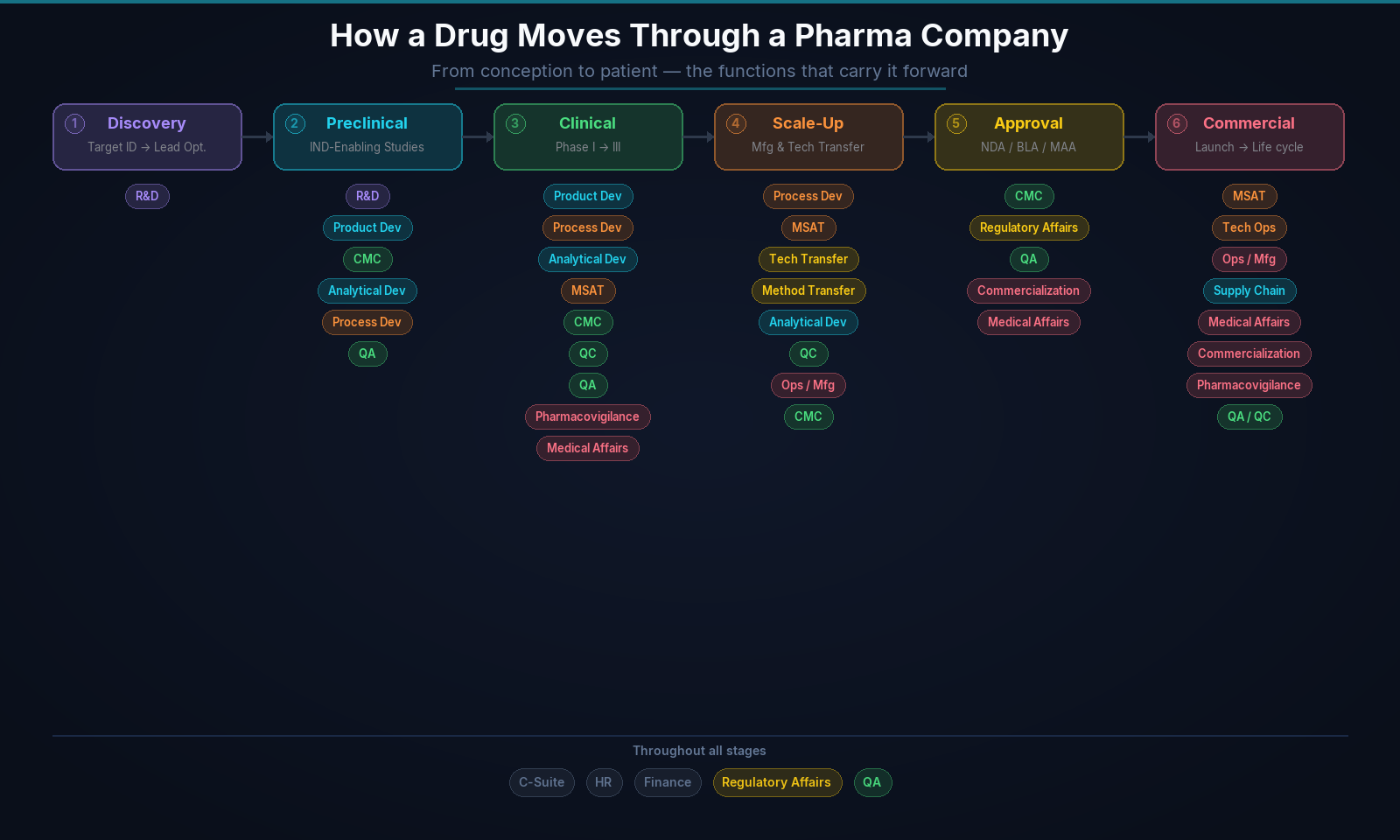
Discovery → Patient
Each stage below shows which functions are active. Most functions span multiple stages — and some never stop.
Pharma 101 /Industry Structure
From the first hypothesis in a lab to the pharmacy shelf — every function that carries a drug forward, what they own, and when they hand off to the next team.
The pipeline
Each stage below shows which functions are active. Most functions span multiple stages — and some never stop.
The origin of everything. R&D identifies biological targets, designs molecules or biologics that interact with them, and runs early experiments to show proof-of-concept. Without R&D there is nothing to develop.
Turns the molecule into a drug product — the right dose, the right form (tablet, injection, inhaler), stable enough to survive manufacturing and patient use. Formulation scientists determine excipients, packaging, and shelf life.
Designs and optimises the manufacturing process for the drug substance (API or biologic). Makes the process scalable, reproducible, and economical — from lab-scale experiments to full commercial-scale production at a CMO (whether that means large chemical reactors for small molecules or multi-thousand-litre bioreactors for biologics).
Creates and validates the testing methods used to measure drug identity, strength, purity, and quality. If Process Development builds the machine, Analytical Development builds the ruler that checks its output.
The bridge between development and manufacturing. MSAT ensures the process developed in the lab actually works at commercial scale and stays in control after launch. They provide technical leadership for process validation (alongside QA, who owns oversight), troubleshoot manufacturing deviations, and drive continuous improvement.
CMC defines the strategy for how a drug is manufactured and controlled — the manufacturing process, specifications, and stability profile — and then compiles that into Module 3 of the regulatory dossier (NDA/BLA/MAA). It is both a scientific discipline and a regulatory filing function, drawing from Process Dev, Product Dev, and Analytical Dev.
Formally moves the manufacturing process from a development or clinical site to the commercial manufacturing facility (or CMO). Ensures the receiving site can reproduce the process within specifications — and documents every step so regulators can verify it.
The analytical parallel to Tech Transfer. Moves validated testing methods from the development lab to the QC lab at the commercial site. The receiving lab must demonstrate they get equivalent results — this is formally documented in a method transfer report.
Tests every batch against the approved specifications before it leaves the site. QC is not development — it runs validated, routine methods and produces the Certificate of Analysis. An OOS (out-of-specification) result triggers a mandatory investigation. Final batch disposition (pass/fail release) is performed by QA or the Qualified Person, not QC.
The systemic function that ensures the quality system is working. Where QC tests the product, QA owns the system that governs how it's made. QA approves SOPs, manages deviations and CAPAs, and hosts regulatory inspections. In the EU, final batch certification is a legal responsibility of the Qualified Person (QP); in the US, this sits with the Quality Unit.
Runs the plant. Executes the Master Batch Records approved by QA, coordinates equipment, operators, and materials to produce drug substance and drug product at scale.
Owns the intersection of manufacturing and science post-launch. Drives continuous improvement of the commercial process, manages lifecycle changes, and ensures the drug keeps meeting spec year after year.
Ensures the right materials arrive for manufacturing and the finished drug reaches distributors under GDP conditions. Cold chain compliance, demand forecasting, and inventory management are core responsibilities.
The function that interfaces directly with the FDA, EMA, MHRA, and other health authorities. Regulatory Affairs prepares and submits the dossier (IND, NDA, BLA, MAA), manages agency interactions, and owns post-approval changes. Getting approval is their deliverable.
The scientific bridge between the company and the medical community. Medical Affairs engages with Key Opinion Leaders (KOLs), generates real-world evidence, supports investigator-initiated studies, and ensures the medical narrative around the drug is accurate and compliant.
Marketing, sales, market access, and pricing. Turns approval into revenue. Works with payers, pharmacy benefit managers, and hospital systems to get the drug on formularies and into patients' hands.
Recruits and retains the scientists, engineers, and leaders that every other function depends on. In a GxP environment, HR also owns training records — a regulatory requirement under cGMP.
CEO, COO, CFO, CSO, Chief Medical Officer, CCO, CLO. Sets portfolio strategy, allocates capital across programs, and makes go/no-go decisions at each stage gate. The C-Suite decides which drugs get developed and how fast.
A drug touches nearly every function — but in a rough sequence. Here's the spine of how it moves.
Sources & further reading
Job titles and handoffs differ by company. These primary sources explain the quality, clinical, manufacturing, and dossier expectations that shape the work described above.
BioCircuit covers the people, functions, and decisions that move drugs from lab to market — every Monday.